The concept of ปัญจอันตรธาน (Panca Antaradhana — The Five Disappearances of Buddhism)
The Five Disappearances or the Five Declines of Buddhism
The concept of ปัญจอันตรธาน (Panca Antaradhana - The Five Disappearances or the Five Declines of Buddhism) did not originate in the canonical texts of the Tripitaka. Instead, the specific five-fold framework was formalized later in the commentarial literature (Atthakatha อรรถกถา).
While the Buddha did speak of the eventual decline of the Dhamma in canonical texts (such as the Gotami Sutta predicting a 500-year decline, which later traditions expanded to 5,000 years), the precise framework originated from the following texts:
1. Manorathapurani (มโนรถปูรณี) - The Primary Origin
The earliest and most authoritative textual origin for the exact five-fold classification is the Manorathapurani. This is the commentary on the Anguttara Nikaya (อังคุตตรนิกาย), compiled by the highly influential Indian scholar-monk Buddhaghosa around the 5th century CE.
Specifically, the concept is detailed in the commentary to the Ekanipata (เอกนิบาต), where Buddhaghosa maps out the 5,000-year timeline of the Gotama Buddha's dispensation (Sasana) and its eventual end.
2. Anagatavamsa (คัมภีร์อนาคตวงศ์) - The Popularizing Text
The concept was heavily popularized and ingrained into Southeast Asian belief systems via the Anagatavamsa (Chronicle of the Future). This is a post-canonical Pali eschatological text (ปกรณ์วิเสส) that focuses on the decline of the current Buddhist era and the future coming of Maitreya (พระศรีอาริยเมตไตรย).
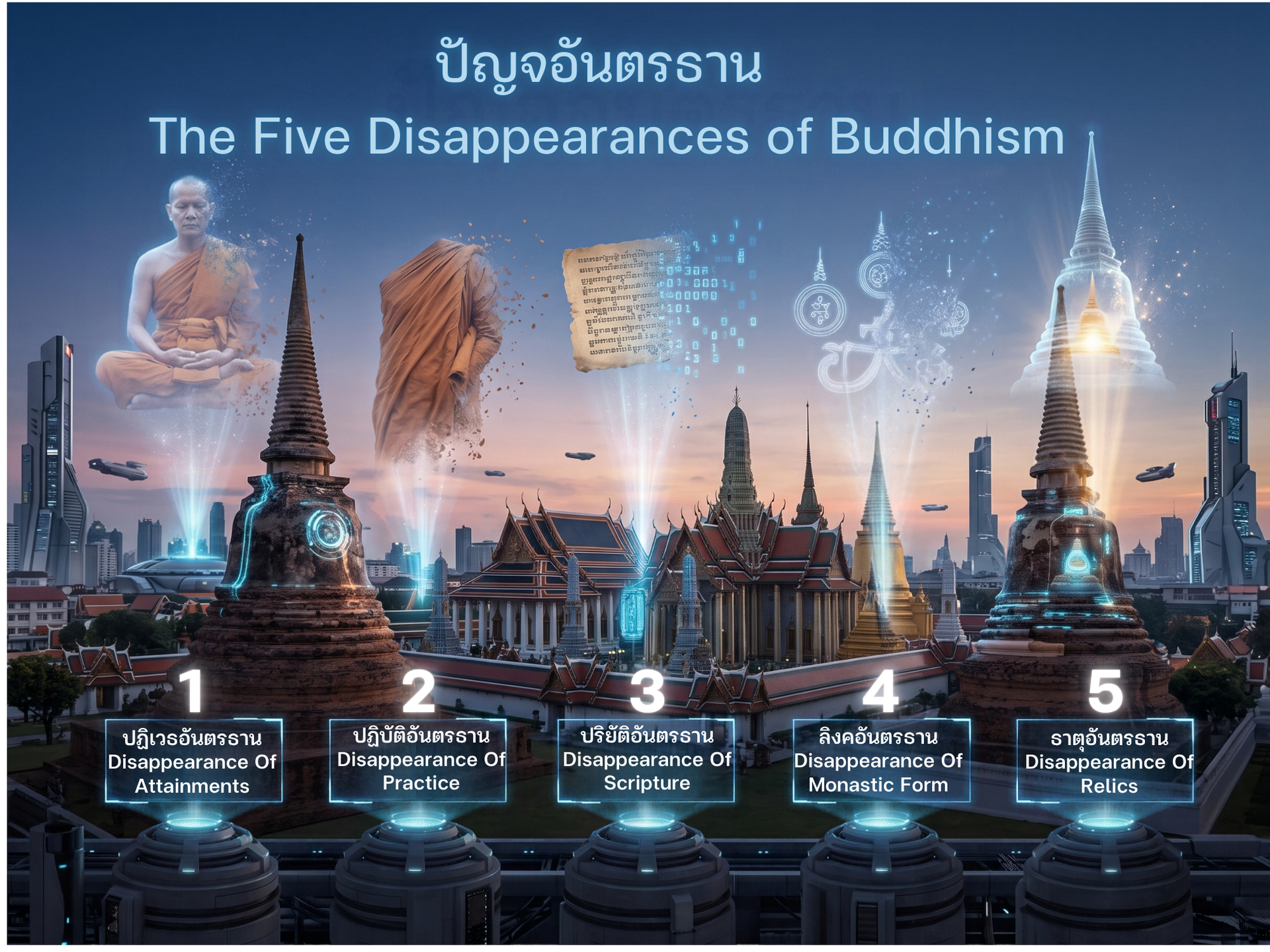
The Five Disappearances
According to the commentarial tradition, the decline will occur sequentially in these five stages over the course of 5,000 years:
| Stage | Pali Term | Disappearance Of | Description |
|---|---|---|---|
| 1 | อธิคมอันตรธาน / ปฏิเวธอันตรธาน (Adhigama/Pativedha) | Attainments | The end of spiritual realization; no more Arahants or Ariya persons can be born. |
| 2 | ปฏิบัติอันตรธาน (Patipatti) | Practice | The loss of meditation (Vipassana) and strict adherence to monastic codes. |
| 3 | ปริยัติอันตรธาน (Pariyatti) | Scripture | The loss of the Tripitaka. The Abhidhamma fades first, followed by the Suttas (with the Vessantara Jataka surviving the longest), and finally the Vinaya. |
| 4 | ลิงคอันตรธาน (Linga) | Monastic Form | Monks abandon their robes; the monastic identity is reduced to merely tying a piece of yellow cloth around the neck or ear |
| 5 | ธาตุอันตรธาน (Dhatu) | Relics | All physical relics of the Buddha miraculously gather at the Bodhi tree for a final display of fire before burning away entirely. |
This commentarial concept profoundly shaped Theravada Buddhist culture. The specific fear of the loss of scripture (ปริยัติอันตรธาน) and the prophecy that the Vessantara Jataka would be the last Sutta to vanish - is the historical driving force behind the widespread tradition of chanting the Mahachat (เทศน์มหาชาติ). It was historically performed to preserve the religion and ensure the listener's rebirth in the prosperous era of Maitreya.
King Lithai (Phra Mahadharmaracha I) utilized the concept of Panca Antaradhana in the Nakhon Chum Inscription (Inscription No. 3) dated 1900 B.E. (1357 CE) as a strategic blend of political survival, religious legitimacy, and social mobilization during a critical turning point for Sukhothai, a maneuver deeply intertwined with his profound devotion to Buddhism.
The geopolitical landscape was shifting rapidly. The newly founded Ayutthaya Kingdom to the south and the Lanna Kingdom to the north were squeezing Sukhothai's influence. King Lithai deployed this eschatological concept to address these pressures through several distinct ways:
King Lithai transitioned the basis of royal authority from a warrior-king model to the Dhammaraja (Righteous Ruler). By highlighting the prophesied 5,000-year decline of Buddhism, he positioned himself as the ultimate spiritual protector. Installing the sacred relic from Sri Lanka and planting the Bodhi tree at Nakhon Chum proved he was actively working to delay this decline.
Stating that Buddhism was approaching the 2,000-year mark created a profound sense of existential anxiety among the populace. The inscription essentially acted as a ticking clock. This urgency compelled citizens to make merit immediately, support the Sangha, and participate in the king's massive public works projects before the opportunity for salvation vanished.
Kamphaeng Phet (Nakhon Chum) was a crucial buffer state. Instead of relying solely on military force to keep the city loyal to Sukhothai, King Lithai used shared religious anxiety. Binding the local elites and citizens to a centralized religious mission under Sukhothai's patronage secured their ideological loyalty.
King Lithai was a highly educated scholar-monk and author of the Traiphum Phra Ruang. The Lankavamsa (Sinhalese) monks he invited to the kingdom brought advanced commentarial texts that detailed the Five Disappearances. Carving this concept into stone was a public display of Sukhothai's alignment with the most prestigious, orthodox Theravada knowledge of the era.
This approaching sense of the Dhamma fading provides a powerful narrative framework for interpreting the massive architectural and religious investments seen across Sukhothai and its outposts during his reign. The rush to build grand monuments wasn't merely for aesthetics; it was a physical attempt to anchor the religion into the landscape before the prophesied decline took root.
In the stone inscription, King Lithai detailed the concept of Panca Antaradhana (ปัญจอันตรธาน), portraying it not as a sudden apocalyptic event, but rather as a gradual decline spanning 5,000 years. According to this account, one specific aspect of the religion is prophesied to disappear every millennium.
The Disappearance of Scripture (Pariyatti)
"...อันว่าพระปิฎกไตรจักหายแล หาคนจักรู้แท้แลมิได้เลย ยังมีคนรู้คันสเล็กสน้อยไซร้ ธรรมเทศนาอันเป็นต้นว่าพระมหาชาติ หาคนสวดแลมิได้เลย ธรรมชาดกอันอื่นไซร้ มีต้นหาปลายมิได้ มีปลายหาต้นมิได้เลย..."
"The Tripitaka will disappear, and there will be no one who truly understands it. Even if there are a few who know a little, there will be no one to chant the Dhamma sermons, especially the Mahachat (the Vessantara Jataka). As for the other Jataka tales, they will have a beginning but no end, and an end but no beginning..."
The Disappearance of Practice (Patipatti)
"...แต่นั้นเมื่อหน้าได้พันปีโสด ฝูงภิกษุสงฆ์อันจำศีลคงสิกขาบทสี่ อันยังมีสิกขาบทอันหนักหนา หามิได้เลย"
"...Another thousand years in the future, the community of monks who strictly observe the precepts and maintain the four major monastic rules will cease to exist entirely."
The Disappearance of Monastic Form (Linga)
"...แต่นั้นเมื่อหน้าได้พันปีโสด อันว่าฝูงชีจักทรงผ้าจีวรหามิได้เลย เท่ายังมีผ้าเหลืองน้อยหนึ่งเหน็บในหูแลรู้จักศาสนาพระเป็นเจ้าดาย"
"...Another thousand years in the future, monks will no longer wear the traditional robes. They will only have a small piece of yellow cloth tucked behind their ear to signify their connection to the Lord's religion."
The Disappearance of Relics (Dhatu)
"...แต่นั้นเมื่อหน้าได้พันปีโสดอันว่าจักรู้จักผ้าจีวร จักรู้จักสมณะน้อยหนึ่งหามิได้เลย ธาตุพระเจ้าที่นี่ก็ดี แห่งอื่นก็ดียังคงเลย"
"...Another thousand years in the future, the monk's robe and the monastic order will vanish entirely. Yet, the Lord's relics—both here and in other places—will still remain.
The Final Extinction of the Religion
"เมื่อปีอันจักสิ้นศาสนาพระพุทธเป็นเจ้าที่สุดทั้งหลายอั้น ปีชวดเดือนหกบูรณมี วันเสาร์วันไทยวันระวายสัน วันไพสขฤกษ์ เถิงเมื่อวันดังนั้น แต่พระธาตุทั้งหลายอันมีในแผ่นดินนี้ก็ดี ในเทพโลกก็ดี ในนาคโลกก็ดี โหะไปกลางหาว และไปผชุมกันในลังกาทวีป เข้าอยู่ในกลวงรัตนมาลิกมหาสดูป แล้วจึงจักโหะไปอยู่ในต้นพระศรีมหาโพธิ์ที่พระพุทธเป็นเจ้าตรัสแก่สรรเพชญเดชญาณเป็นพระพุทธเมื่อก่อนอั้น จึงจักกาลไฟไหม้พระธาตุทั้งอั้นสิ้นแล เปลวพุ่งขึ้นคุงพรหมโลก สาสนาพระพุทธจักสิ้นในวันดังกล่าวอั้นแล ...."
"In the final year when the Buddhist religion is destined to completely end - the Year of the Rat, the sixth lunar month on the full moon, on a Saturday, a Thai calendar day of Rawaai San, under the Visakha auspicious alignment—when that day arrives, all the sacred relics on this earth, in the realm of the devas, and in the Naga world, will float into the sky. They will gather together in the island of Lanka, entering the great Ruwanweli Seya stupa (Ratanamali Mahathupa). From there, they will float to the Great Sri Maha Bodhi tree where the Lord Buddha previously attained Omniscience. Then, a great fire will erupt and burn all the relics completely, with flames soaring up to the Brahma realm. The Buddhist religion will come to its absolute end on that very day..."